AMMAN, Jordan – A catastrophic humanitarian crisis is unfolding across Syria as millions of displaced civilians return home to a landscape littered with unexploded bombs and landmines. Since the fall of the Assad regime on December 8, 2024, at least 1,500 people have been killed or injured by deadly remnants of war, according to the International NGO Safety Organization (INSO). The group reports that more than 423 children have sustained injuries, and at least 165 have died.
According to the independent aid organization Humanity Inclusion (HI), an estimated 1 million munitions were used during the war, leaving a deadly legacy of between 100,000 and 300,000 explosive items scattered across the country. These hazards are not confined to former frontlines; they are found in agricultural fields, along roads, and buried in the rubble of schools and hospitals. The UN Children’s Fund (UNICEF) estimates that approximately 5 million children live in areas contaminated by these lethal threats. Simple, essential activities—farming a field, collecting firewood, or playing outside—can lead to death or life-altering injury in an instant.

Aid groups are calling on donors to urgently increase funding for clearance operations, risk education programs, and comprehensive support for survivors, who require long-term medical care, rehabilitation, and psychosocial services.
To address the crisis, 3DP4ME has dispatched teams of experienced professionals from Jordan to Syria. We have partnered with the Syrian Ministry of Health and the Syrian American Medical Society (SAMS) to bring our specialized combination of care—using the latest technology for prosthetic reconstruction along with a holistic approach to long-term recovery—to all of our patients.
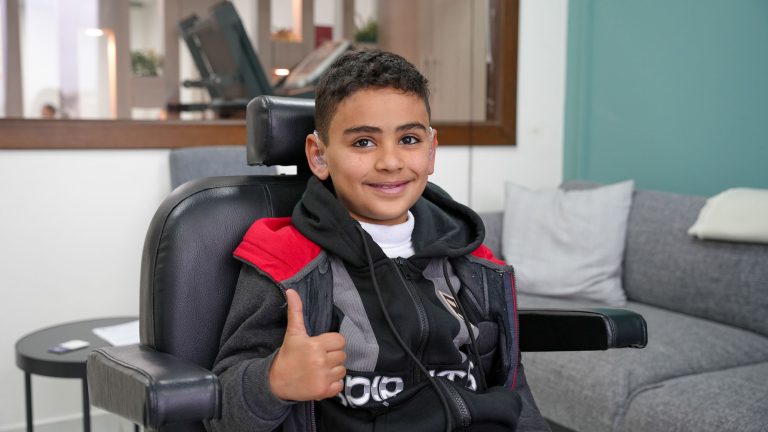
The process represents a shift in how medical aid is delivered in volatile regions. For 13-year-old Younes, who lost his right leg to a landmine while tending sheep earlier this year, the fitting process began not with a plaster mold, but with a smartphone.
In a Damascus clinic, 3DP4ME technicians used a phone to create a 3D digital scan of Younes’ residual limb. The data was transmitted to our headquarters in Amman, where a custom prosthetic was designed and printed using a specialized carbon fiber printer. The finished limb was delivered and fitted in November.

“Fitting him with a new limb and watching him stride down the hallway was a beautiful moment, but we know it was just the start of his restoration process – he’s still angry, and it’s going to take time to unpack that,” says Amira, director of Holistic Care with 3DP4ME.
Patients face big challenges after being fitted with a new limb. The care team will visit Younes again in January as part of the organization’s long-term support. They will address any physical challenges he is experiencing while ensuring the prosthetic is comfortable and being worn.

“Many children outgrow their prosthesis every six months, requiring re-measurement, redesign, and re-printing—another reminder that meaningful care doesn’t end with delivery, but grows alongside the child,” says Codi Halbur, a staff physiotherapist with 10-years of experience.
While technology accelerates the physical recovery, care team members emphasize that the psychological toll remains a significant hurdle.

“Many children struggle with self-esteem, behavioral challenges, or experience bullying at school. Families are often navigating how best to support them. We provide encouragement, share stories, and practice role-playing for difficult social situations, and remind each child that they are not alone—we are part of their team, and they have inherent worth and value,” says Codi.
The unexploded ordnance (UXO) crisis in Syria is expected to grow as more internally displaced persons (IDPs) and refugees return to rebuild their lives from the ruins of the 14-year civil war.
3DP4ME and other organizations face the challenge of how to make a meaningful impact. Founder and CEO, Jason Szolomayer says the key is not trying to tackle the problem alone. “If we want to make a long-term difference, we’ve got to link arms with others, like SAMS and the Ministry of Health, who have been doing the hard work for a long time. We are just one piece of the puzzle, and we’re trying to build a community of people who want to accelerate healing for kids in tough places,” he says.
To help meet the extensive need and better serve patients, we would like to set up a local office in Syria consisting of a country director, a certified prosthetist/orthotist, and a holistic care team that can follow up with patients and families in their homes.
With donations from concerned people like you, we can help bring hope and healing to more kids in Syria.